

The Borgo Teresiano in Trieste: History and Points of Interest


The Borgo Teresiano takes its name from Empress Maria Theresa of Austria, who aimed to establish a new commercial center in the city. Today, this neighborhood stands as one of the most captivating areas in Trieste and a must-visit for anyone interested in the city’s history and architecture. In this brief guide, we will explore the attractions and unique features of this charming district in the heart of Trieste.
Borgo Teresiano: A Bit of History
The designation of Trieste as a free port in 1719 by Emperor Charles VI led to a significant economic boom in the city, as well as rapid population growth. In 1730, Charles VI decided to expropriate the salt fields on the city’s outskirts to found a new district and make room for the burgeoning population.
The task of furthering and expanding her father’s project fell to his daughter, Empress Maria Theresa. The territorial development plan was entrusted to Johann Conrad de Gerhardt, while the construction project was overseen by a building committee led by Francesco Bonomo.
Borgo Teresiano: Key Points of Interest
Borgo Teresiano is one of the most fascinating and evocative neighborhoods in Trieste, as it exemplifies modern urban planning and architectural excellence that has stood the test of time.
The Grand Canal
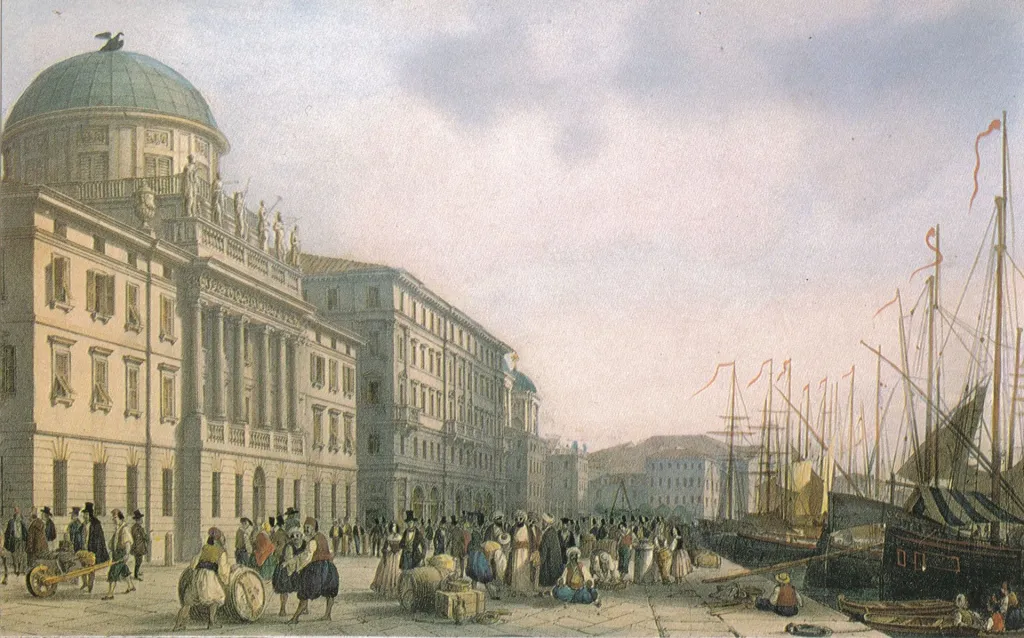
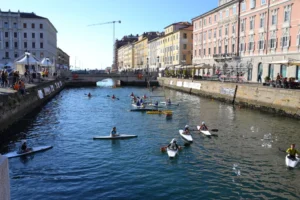
The Grand Canal is the heart of the Borgo Teresiano. Extending at a right angle from the road that leads from the port to the city, it seamlessly integrates with the neighborhood’s grid-like layout. The canal was designed to allow commercial ships to enter the city center for loading and unloading goods destined for the rest of the Empire.
Along the canal, you’ll find the churches of Sant’Antonio Taumaturgo and the Holy Trinity and St. Spiridione, as well as the ancient private homes of merchants, primarily from Greece and Serbia. Notable examples include Palazzo Carciotti, Palazzo Gopcevich, and Palazzo Scaramangà.
Piazza Ponterosso
Piazza Ponterosso directly overlooks the Grand Canal and was completed in 1854. It serves as the first square of the new Teresian District and gets its name from the red-painted wooden drawbridge that once led to the other side of the canal and has since been replaced.
The square is dominated by the Fountain of Giovannin, built by Giuseppe Mazzoleni in 1753 and linked to the aqueduct also built during Maria Theresa’s time. Today, Piazza Ponterosso is a bustling gathering spot featuring eateries and restaurants catering to all ages, along with various cultural and gastronomic events throughout the year.
Sant’Antonio Nuovo Church
Built between 1823 and 1849 and designed by Ticinese architect Pietro Nobile, the church was consecrated in 1842 and is now Trieste’s largest Catholic church. Its neoclassical façade features a portico with six Ionic columns supporting a triangular pediment. Above this sits a balustrade with statues of eight martyrs from Trieste, topped by a dome.
Inside the single-nave church, one can find works from various 18th and 19th-century Venetian painters, like the “Visitation of the Virgin” (1769) by Alessandro Longhi (1733-1813), son of Pietro Longhi.
Palazzo Carciotti
Located at the entrance of the Grand Canal, Palazzo Carciotti was constructed between 1802 and 1805 by wealthy Greek merchant Demetrio Carciotti under the direction of architect Matteo Pertsch, creating one of the most important examples of classicism in Trieste.
The façade features a portico with six Ionic columns supporting a parapet adorned with allegorical statues of the six main Olympian deities. Inside, the focal point is the circular hall beneath the dome, graced by rich interiors decorated with numerous frescoes by Giuseppe Bernardino Bison and statues by Antonio Bosa.
Real Estate in the Borgo Teresiano in Trieste
The Teresian District in Trieste is one of the city’s most elegant and refined neighborhoods, marked by exquisite architecture and a genteel ambiance. Real estate in this area is top-tier, ranging from ancient noble residences to modern luxury residential structures.
In addition to residential buildings, the Teresian District hosts numerous commercial activities and fashion boutiques, prestigious restaurants, and luxury shops, making it an area with strong tourist presence, especially in the summer. Properties in the Teresian District are highly sought after and represent an intriguing investment for those looking for prestigious housing in one of the city’s most captivating zones.
Borgo Teresiano is one of the most expensive and liquid areas in Trieste, where buyers are not just paying for square meters but for location, historical value, and long-term resale potential. As of 2026, average prices typically range between €3,300 and €3,800 per square meter, with lower-end properties in need of renovation starting around €2,700 per square meter and premium units exceeding €4,600 per square meter.
The majority of listings fall within a broad range of approximately €2,100 to €4,100 per square meter, with a realistic median around €3,600. Compared to the overall Trieste average of about €2,600 per square meter, Borgo Teresiano commands a premium of roughly 25% to 40%, reflecting its strong and stable positioning rather than speculative growth.
This area benefits from consistently high liquidity, sustained international demand, and a limited supply of historic buildings, all of which support long-term price resilience.
In practical terms, a typical one-bedroom apartment ranges from €200,000 to over €300,000, a two-bedroom from €280,000 to €450,000 or more, while top-floor or canal-view properties can easily exceed €500,000 and reach beyond €1 million. Entry-level budgets below €100,000 are effectively excluded from this market, making it a strategic choice primarily for buyers seeking capital preservation, strong resale potential, and international appeal.
Are you looking for a property in Borgo Teresiano? We are the leading Property Finder service in Trieste and we’ll be glad to help. Reach us for a free consultation now!