


Buying property in Cortina d’Ampezzo is not a simple real estate transaction. It is a strategic, long-term asset decision that requires in-depth local knowledge, access to the right information, and careful risk management. For a foreign buyer, the level of complexity increases: language barriers, legal regulations, market dynamics, and unwritten practices make the process far from intuitive.
Cortina is an exclusive, opaque, and highly competitive market, where many of the best opportunities never appear on traditional real estate portals. Prices vary significantly depending on micro-locations, exposure, property condition, and urban planning context. What appears “available” online often represents only a portion — and not always the best — of the actual market supply.
This guide is designed for international buyers who want to purchase property in Cortina d’Ampezzo in a well-informed, secure, and strategic way. We will analyze the market, pricing levels, the most attractive areas, the purchasing process for non-residents, and the main pitfalls to avoid. In particular, we will explain why working with an independent Property Finder, who acts exclusively in the buyer’s interest, can make the difference between a solid investment and a costly mistake.
Why Is Cortina d’Ampezzo So Attractive?
Cortina d’Ampezzo is attractive because it combines three elements that rarely coexist in the high-end real estate market: stable international demand, structurally limited supply, and a strong territorial identity. It is not simply a “trendy” destination; it is a consolidated, recognizable, and highly desirable brand that continues to attract foreign buyers for lifestyle, status, and capital preservation reasons.
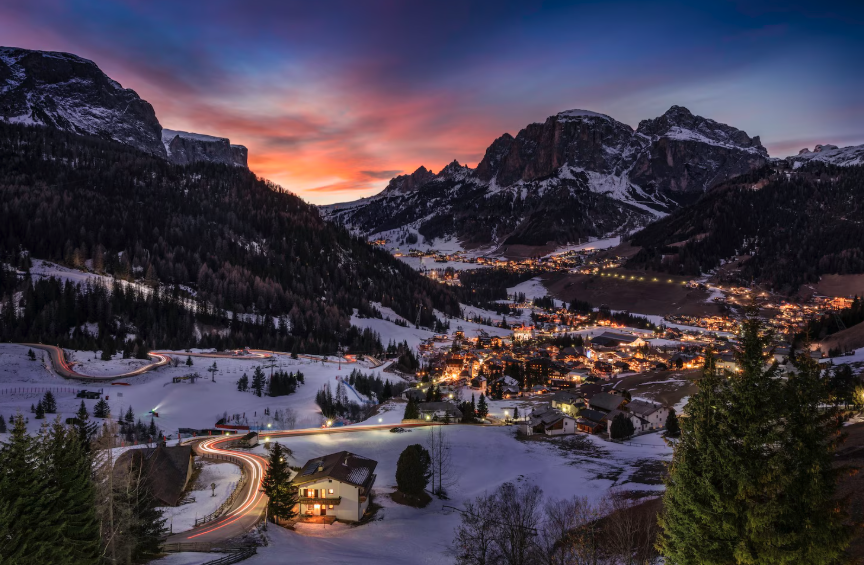
The primary driver is scarcity. The availability of truly premium properties is limited (due to physical, urban planning, and landscape constraints), which tends to support long-term values—especially for assets with rare features such as views, exposure, privacy, accessibility, architectural quality, and context. At the same time, the experience Cortina offers is difficult to replicate: nature, sports, high-level services, and a well-developed tourism ecosystem. The result is a market that behaves more like a “private club” than a traditional real estate marketplace.
Finally, there is an operational factor that is often underestimated: Cortina rewards those who navigate it with local intelligence. Many opportunities never enter public channels, prices are influenced by micro-dynamics, and the quality of information is uneven. In this environment, the key differentiator is the ability to read the territory and filter properties through an investor’s lens: true asset quality, technical and urban planning risks, and future resale potential. In short, Cortina is attractive because it is an aspirational destination—but above all because it is a market where strategy matters more than speed.
Is It Possible to Buy Property in Cortina d’Ampezzo as a Foreigner?
Yes, buying property in Cortina d’Ampezzo is absolutely possible for foreign citizens. However, the framework changes significantly depending on the buyer’s nationality and tax residence. From a legal standpoint, Italy allows non-Italian individuals to purchase real estate, but not all foreign buyers are treated equally. Moreover, Cortina is a market that requires an above-average level of preparation and due diligence.
For European Union citizens, the purchase process is essentially equivalent to that of an Italian citizen: there are no specific restrictions, and the procedure is straightforward. For non-EU citizens, the principle of reciprocity applies. This means that a foreign national can purchase property in Italy only if their home country grants the same right to Italian citizens. This aspect is often underestimated and must be verified before entering into negotiations, in order to avoid complications at an advanced stage of the transaction.
From an operational standpoint, foreign buyers must complete additional mandatory steps: obtaining an Italian tax code (codice fiscale), opening an Italian bank account, coordinating documentation with the notary, and properly managing tax and urban planning matters. In Cortina, where many properties are subject to landscape, historical, or planning restrictions, a superficial review can result in delays, unexpected costs, or, in the worst cases, the inability to complete the purchase.
The critical issue is not whether a foreigner can buy property in Cortina, but how to do so correctly. Entering this market without a structured local support system means operating in a relatively opaque environment, with information asymmetry and a high margin for error.
Book a free call: we’ll explain how we can help you find your dream home in Cortina d’Ampezzo.
What Is Required to Buy Property in Cortina d’Ampezzo?
Buying property in Cortina d’Ampezzo is not just about identifying the right asset. It requires a precise legal and operational structure, which for foreign buyers often represents the real friction point. On paper, the requirements are clear. In practice—especially in a complex market such as Cortina—they demand method, coordination, and rigorous due diligence.
In summary, the following are required:
- Italian Tax Code (Codice Fiscale)
This is mandatory for any legal and tax-related transaction in Italy. It can also be obtained from abroad, but timing and procedures must be carefully planned to avoid slowing down negotiations. - Valid Identification Document
A passport or national ID card, with particular attention to the consistency of personal data across all official documents. - Verification of the Reciprocity Principle (for non-EU citizens)
Often overlooked, yet decisive. Without verifying reciprocity, the purchase can be blocked at the notarial stage. - Italian Bank Account
Not always legally mandatory, but in practice necessary to manage deposits, taxes, notary fees, and utilities. Opening an account as a foreigner requires preparation and lead time. - Notarial Deed and Appointed Notary
The notary plays a central role in the transaction but does not provide strategic advisory services on the property itself. Arriving at the notary without having conducted prior due diligence exposes the buyer to avoidable risks. - Urban Planning and Cadastral Due Diligence
In Cortina, this is critical. Irregularities, landscape restrictions, or usage limitations are common and must be assessed before signing any offer. - Tax Structuring of the Transaction
Purchase taxes, acquisition regime, potential tax residency implications, and intended use of the property (private residence, investment, rental) must be structured in advance.
The issue is not the checklist of documents—it is the orchestration. Without centralized coordination, a foreign buyer risks delays, additional costs, and decisions made on incomplete information. A locally operating Property Finder in Cortina works precisely on this level: preparing the ground, anticipating risks, and ensuring that the transaction reaches completion with full operational control.
The Real Estate Market in Cortina d’Ampezzo: A Brief Historical Overview
Cortina d’Ampezzo did not become a luxury destination by chance. Its evolution is the result of a unique combination of history, geography, culture, and international positioning, which gradually transformed it from an Alpine valley into an iconic European lifestyle destination.
Until the late 19th century, Cortina was primarily a mountain community rooted in craftsmanship and agriculture. The first major shift occurred with the arrival of elite Alpine tourism: initially the Austro-Hungarian aristocracy, followed by the Central European bourgeoisie. Its strategic location between the Germanic and Italian worlds immediately attracted an international audience with refined tastes and strong purchasing power.
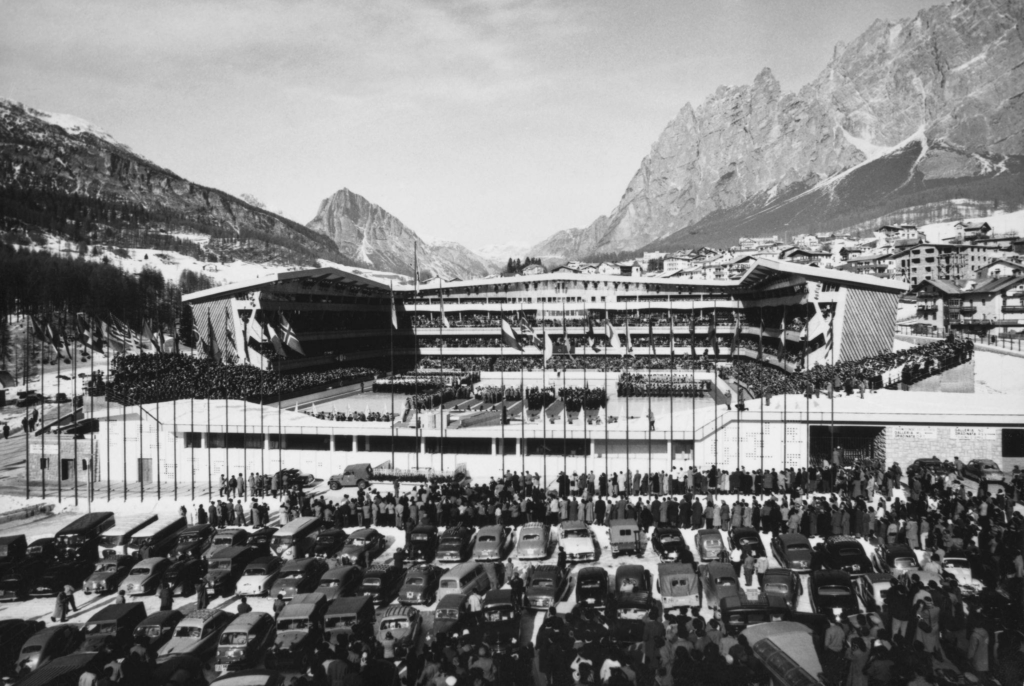
The real turning point came in the post-war period. The 1956 Winter Olympics projected Cortina d’Ampezzo onto the global stage, transforming it into a symbol of modernity, sport, and high society. Cortina became known as the “Queen of the Dolomites”: not only skiing and mountains, but also cinema, international events, jet-set culture, and a distinctive aesthetic defined by elegant Alpine architecture, historic hotels, and a high-profile social scene.
In the decades that followed, unlike many other tourist destinations, Cortina did not expand indiscriminately. Landscape and urban planning restrictions, combined with a strong local identity, limited mass development and preserved the territory. This constrained real estate supply while reinforcing a long-term perception of exclusivity: limited properties in a unique setting became a scarce and highly desirable asset.
In recent years, Cortina has entered a new growth phase. Renewed international visibility, infrastructure investments, and its positioning as a “four-season” destination have consolidated its status as a premier Alpine luxury market. Today, Cortina is not merely a tourist location but a prestige asset, chosen by international families, entrepreneurs, and investors seeking quality of life, discretion, and capital protection.
It is this historical continuity—never interrupted, never diluted—that makes Cortina distinctive. It is not a recent trend, but a destination that has built its value over time. That measured development and strong identity explain why buying property in Cortina today means entering a selective, resilient market structurally oriented toward luxury.
How the Property Purchase Process Works in Cortina d’Ampezzo
The process of buying property in Cortina d’Ampezzo follows the structure established by Italian real estate law. However, local practices and the specific market environment make it far less straightforward than it may appear. For a foreign buyer, the main risks are not legal but operational: misaligned timelines, partial information, and decisions made without a comprehensive strategic overview.
In practical terms, the process unfolds in five key stages.
1. Defining the Acquisition Strategy
Before even searching for a property, it is essential to clarify objectives, real budget capacity, time horizon, and intended use (second home, investment, family residence). In Cortina, entering the market without a clear strategy means chasing what is available rather than acquiring what is strategically appropriate.
2. Property Search and Selection
This is the most critical phase. A significant portion of high-quality properties is never publicly advertised and circulates through private channels. Online information is often incomplete or outdated. The selection process must already include an initial technical and urban planning screening, as well as an assessment of price alignment with intrinsic value.
3. Purchase Offer and Negotiation
Once the property is identified, a formal offer is submitted. At this stage, deposits are typically paid and conditions, timelines, and any suspensive clauses are defined. In Cortina, negotiation is rarely standardized: price is not the only variable, and leverage depends heavily on how well the initial positioning has been structured.
4. Due Diligence and Verification
Between the accepted offer and the final deed, the most sensitive phase takes place: cadastral and urban planning checks, verification of landscape restrictions, building compliance, condominium matters, and tax position. Many issues surface at this stage, particularly with historic properties or those renovated over time.
5. Notarial Deed and Transfer of Ownership
The notary formalizes the transfer but does not assess the strategic quality of the transaction. Reaching the deed with all technical and legal aspects already verified is essential to avoid last-minute surprises or costly delays—especially for buyers who do not reside in Italy.
In summary, the process works only if it is actively governed. In Cortina, a foreign buyer who passively follows local market dynamics relinquishes control and negotiation leverage. A structured approach—with a professional coordinating search, due diligence, and negotiation exclusively in the buyer’s interest—transforms a complex pathway into a manageable, efficient transaction aligned with long-term asset objectives.
Buying as a Primary or Secondary Residence? (“Prima Casa” or “Seconda Casa”)
In Cortina d’Ampezzo, the distinction between a primary residence and a secondary residence is not merely formal. It directly impacts taxation, acquisition strategy, and the intended use of the property. For a foreign buyer, this decision must be made upfront, as modifying it later is often complex or inefficient.
Purchase as a Primary Residence (“Prima Casa”)
This option is viable only if specific requirements are met: residency in Italy (or a formal commitment to transfer it), continuous residential use, and compliance with the conditions set by Italian tax law. The benefits are mainly fiscal in nature. However, for many international buyers, this route has limited practical applicability. Transferring residency entails tax, civil registry, and sometimes asset-related obligations that must be carefully evaluated—especially if the buyer’s center of interests remains abroad.
Purchase as a Secondary Residence (“Seconda Casa”)
This is by far the most common option in Cortina for foreign buyers. It offers greater flexibility, fewer constraints, and management aligned with the typical use of the destination: seasonal stays, family use, or potential rental income. From a tax perspective, the burden is higher than for a primary residence, but it is predictable, manageable, and compatible with an international wealth strategy.
The key issue is not selecting the “most tax-efficient” option in abstract terms, but the most sustainable structure over time. In Cortina, a well-acquired secondary residence—located in the right micro-area and featuring liquid market characteristics—preserves value and maintains strategic optionality: resale, generational transfer, or change of use.
For this reason, the primary versus secondary residence decision should be an integral part of the acquisition strategy, not a last-minute consideration at the notarial stage. A Property Finder acting exclusively for the buyer ensures alignment between personal objectives, tax structuring, and real estate strategy—avoiding solutions that are formally correct but strategically ineffective.
How the Purchase Process In Cortina d’Ampezzo Works for a Foreign Buyer
For a foreign buyer, purchasing property in Cortina d’Ampezzo is not simply an adaptation of the standard Italian process. It is a structured pathway requiring additional steps, tighter coordination, and minimal room for improvisation. While the law permits foreign ownership, the success of the transaction depends on properly managing bureaucratic, tax, and operational aspects that are not intuitive for non-residents.
The first step is defining the buyer’s legal framework. EU and non-EU citizens are subject to different rules, particularly regarding the principle of reciprocity. This verification must be carried out at the outset—not during advanced negotiations—because it directly affects the ability to complete the purchase.
Next comes the setup of the operational infrastructure: obtaining an Italian tax code, potentially opening an Italian bank account, organizing personal documentation, and coordinating with the notary. These tasks may appear straightforward, but for a foreign buyer they can cause significant delays if handled without local support.
Property Search
The search phase requires careful alignment between the buyer’s actual needs and the characteristics of the available supply. In Cortina, the market is fragmented and strongly influenced by micro-locations, exposure, context, and property condition. Available information is not always homogeneous and must be correctly interpreted to avoid superficial assessments or misleading comparisons between seemingly similar properties.
Negotiation
Negotiation is a delicate stage involving timing, conditions, and transaction structure—not just price. For a foreign buyer, negotiating without precise knowledge of the local market can result in unnecessary concessions or counterproductive rigidity. Effective negotiation is based on concrete data, coherent valuation, and proper management of expectations on both sides.
Purchase Offer
The purchase offer formalizes the buyer’s intent and defines the key elements of the transaction: price, deposit, timelines, and conditions. At this stage, it is essential to structure protective clauses correctly—particularly those related to technical, urban planning, and documentary verifications. For a foreign buyer, a clear and properly drafted offer significantly reduces operational risk.
Notarial Deed
The notarial deed concludes the process and officially transfers ownership. The notary verifies the legal validity of the act and the formal correctness of documentation but does not assess the strategic quality of the purchase. Reaching this stage with all verifications already completed allows the foreign buyer to finalize the transaction smoothly, without last-minute surprises or costly delays.
In summary, the purchase process for a foreign buyer in Cortina d’Ampezzo functions effectively only if each phase is managed in a coherent and sequential manner. A centralized coordination of search, negotiation, and due diligence reduces complexity and uncertainty—transforming a potentially burdensome path into a controlled, transparent transaction aligned with long-term asset objectives.
Where to Buy Property in Cortina d’Ampezzo
Choosing the right area is one of the primary drivers of a successful real estate acquisition in Cortina d’Ampezzo. There is no single “best area” in absolute terms: each micro-location has specific characteristics in terms of context, accessibility, views, sun exposure, and future liquidity. For a foreign buyer, area selection must be guided not only by quality of use, but also by long-term value sustainability.
Historic Center and Main Streets
Cortina’s town center is the logical choice for those seeking convenience, proximity to restaurants, boutiques, and infrastructure, as well as a strong local identity. Properties here tend to retain value due to consistent demand for well-located second homes. However, they may be subject to stricter urban planning constraints and often offer more compact spaces compared to outer residential areas.
Panoramic Residential Areas
Areas slightly outside the center—such as Borgo Faloria, Chiave, and Alverà—often provide open views of the Dolomites, favorable sun exposure, and greater privacy. These elements translate into stable demand from buyers focused on residential quality and perceived exclusivity. From an investment perspective, such locations generally perform well at resale, provided the property combines view, accessibility, and architectural coherence.
San Vito di Cadore and the Cadore Area
San Vito di Cadore, and more broadly the Cadore area, represent a concrete alternative to Cortina d’Ampezzo for those seeking a high-quality mountain setting at more accessible price levels and with a more relaxed lifestyle, while remaining close to Cortina itself. San Vito, in particular, is just a few minutes by car and well connected, making it a rational option for those who frequent Cortina but do not require a central location.
From a real estate perspective, these areas often offer larger floor plans, more recent buildings or properties subject to fewer restrictions than in Cortina, and greater availability of solutions with outdoor space, garages, or parking. For families or buyers seeking a second home to use regularly, San Vito di Cadore can provide a stronger balance between comfort, management costs, and overall quality of life.
Adjacent and More Accessible Locations
Areas immediately surrounding central Cortina—such as Fiames or locations with convenient access to ski facilities—can offer a balanced combination of price and appreciation potential. These zones often feature larger units, outdoor spaces, and less restrictive planning conditions compared to the historic center, while still remaining within the core area of interest.
Key Factors to Consider When Choosing the Area
Area selection should begin with a concrete assessment of intended use. Buyers planning short and frequent stays typically prioritize central or well-connected areas, where daily life can be managed on foot even during peak season. Conversely, those seeking a second home for extended stays or family use may benefit more from residential, panoramic, and quieter locations, even if this implies a few additional minutes of travel.
Another decisive factor is actual accessibility—not theoretical proximity. A property with exceptional views but difficult winter access, limited parking, or steep roads may prove impractical for everyday use. For example, a well-exposed home without a parking space in a congested area may lose attractiveness faster than a slightly more peripheral property that remains easily accessible year-round.
Long-term value resilience must also be evaluated. Certain micro-locations in Cortina demonstrate broader and more stable demand, making properties more liquid in case of resale. An apartment close to primary services or with features easily understood by an international audience is generally easier to reposition on the market than highly specific or niche solutions.
Finally, urban planning and landscape constraints—often invisible at first glance—play a critical role. In some areas, the ability to renovate, expand, or modify the internal layout can be significantly limited. A typical example is the purchase of a visually charming property with minimal intervention potential, which over time reduces flexibility and market appeal.
In summary, choosing the right area in Cortina means anticipating both risks and opportunities rather than reacting to them later. Evaluating these factors with practical examples enables more strategic, less emotional decision-making—aligning the acquisition not only with personal taste, but with long-term value logic and sustainability.
Cortina d’Ampezzo and the 2026 Winter Olympics
The Milano Cortina 2026 Winter Olympics represent one of the most significant milestones in the recent history of Cortina d’Ampezzo. This is not merely a major sporting event, but a structural accelerator that has already impacted—and will continue to impact—infrastructure, international visibility, and the destination’s medium- to long-term positioning.
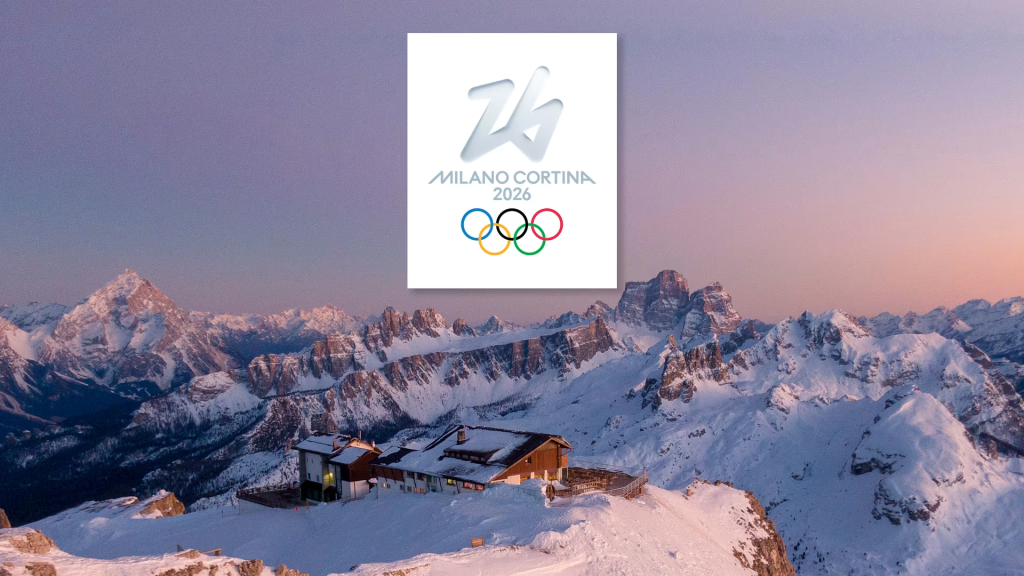
Cortina is one of the central venues of the Games, returning to the global stage seventy years after the 1956 Winter Olympics. This return has triggered a targeted investment cycle, markedly different from past approaches: less indiscriminate expansion, more redevelopment, modernization, and long-term functional upgrades.
From an infrastructure standpoint, interventions have focused on:
- Road networks and accessibility, improving traffic management and regional connections.
- Sports facilities, renovated or rebuilt to meet international standards while ensuring sustainable post-Olympic use.
- Urban services and public spaces, with increased emphasis on sustainability, safety, and overall quality of experience.
From a real estate perspective, the Olympic impact should not be interpreted as a short-term speculative dynamic. The real effect lies in strengthening the Cortina brand: enhanced global exposure, consolidation of international demand, and reaffirmation of its positioning as a premier Alpine destination. In markets of this caliber, structural visibility carries more weight than temporary price spikes.
It is important to note that Cortina d’Ampezzo has approached the Olympic cycle with a disciplined strategy: no uncontrolled new construction and strict territorial governance. This approach has limited the expansion of real estate supply, preserved asset scarcity, and reduced the risk of post-event oversupply—an imbalance that has affected other destinations after major global events.
Buying Property in Cortina with a Strategic Approach
Buying property in Cortina d’Ampezzo goes far beyond selecting an asset. It is a decision involving capital allocation, time commitment, expectations, and risk management. For a foreign buyer, the core issue is not market access, but process quality: accurate information, controlled timelines, coherent decision-making, and the absence of unforeseen complications.
Our Property Finding service is designed to represent exclusively the buyer’s interests and to guide the entire transaction lifecycle: from defining the acquisition strategy to sourcing the right property, from negotiation to technical and bureaucratic due diligence, through to completion of the notarial deed.
We operate on a percentage-based fee model fully aligned with the client’s interests. In most cases, our compensation is effectively offset by the savings achieved during negotiation, the prevention of costly errors, and the correct structuring of the transaction from the outset. The objective is not merely to identify a property, but to secure it at the right price and under the right conditions.
A key differentiator is our established network of experienced professionals. We work closely with notaries, technical experts, tax advisors, and legal consultants specialized in cross-border real estate transactions. This integrated approach ensures coordinated management of urban planning, tax, and legal aspects—eliminating fragmentation and significantly reducing the risk of delays or inconsistencies.