

Condominium Fees in Italy: What They Are, How They Work, and Who Pays Them


Buying an apartment in Italy often means becoming part of a condominium, a system in which multiple property owners share responsibility for common areas and building services. Along with ownership comes the obligation to contribute to condominium fees, known in Italian as spese condominiali. These fees cover a wide range of expenses, from cleaning and maintenance to administrative costs and major building renovations.
Whether you are a homeowner, a prospective buyer, an investor, or an expat looking to purchase property in Italy, understanding how condominium fees work is essential. The amount you pay can vary significantly depending on the building’s characteristics, the services provided, and the rules governing expense allocation.
In this guide, we explain what condominium fees in Italy are, how they are calculated, which costs they include, and what responsibilities property owners have. We will also explore the differences between ordinary and extraordinary expenses, the role of the condominium administrator, and key considerations for foreign buyers navigating the Italian real estate market.
What Are Condominium Fees in Italy?
Condominium fees in Italy, known as spese condominiali, are the contributions that property owners pay to cover the costs associated with managing, maintaining, and operating the shared areas of a residential building. These expenses are a fundamental aspect of condominium ownership and ensure that common spaces and services remain functional, safe, and well-maintained for all residents.
In most apartment buildings, owners collectively share responsibility for areas such as staircases, elevators, hallways, gardens, courtyards, parking areas, and building systems. The costs related to these shared spaces are divided among owners according to specific allocation criteria established by Italian condominium law and the building’s regulations.

Condominium fees can include routine expenses such as cleaning, lighting, maintenance, insurance, and administrative services, as well as contributions toward larger repair or renovation projects when necessary. The exact amount varies depending on factors such as the size of the property, the building’s amenities, and the services provided.
Understanding condominium fees is particularly important for foreign buyers and investors, as these costs represent an ongoing financial commitment that goes beyond the purchase price of a property. Reviewing a building’s condominium expenses before buying can help avoid unexpected costs and provide a clearer picture of the property’s overall affordability.
The Role of the Condominium Association
In Italy, when a building contains multiple privately owned units and shared spaces, all property owners automatically become members of the condominium association (condominio). This collective body is responsible for managing and preserving the common areas of the building while ensuring that all owners contribute fairly to shared expenses.
The condominium association oversees elements that belong to all residents, such as staircases, elevators, roofs, facades, gardens, parking areas, and technical systems serving the entire building. Decisions regarding maintenance, repairs, improvements, and budget approval are typically made during condominium meetings, where owners vote on matters affecting the property.
To facilitate day-to-day management, many condominium associations appoint a condominium administrator (amministratore di condominio). The administrator handles financial management, collects condominium fees, organizes meetings, coordinates maintenance work, and ensures compliance with legal obligations.
Although each owner has exclusive rights over their individual apartment, shared ownership of common areas means that certain decisions and expenses must be managed collectively. This system helps maintain the building’s value, ensures proper upkeep of communal spaces, and promotes the smooth functioning of the residential community.
Ordinary and Extraordinary Condominium Expenses
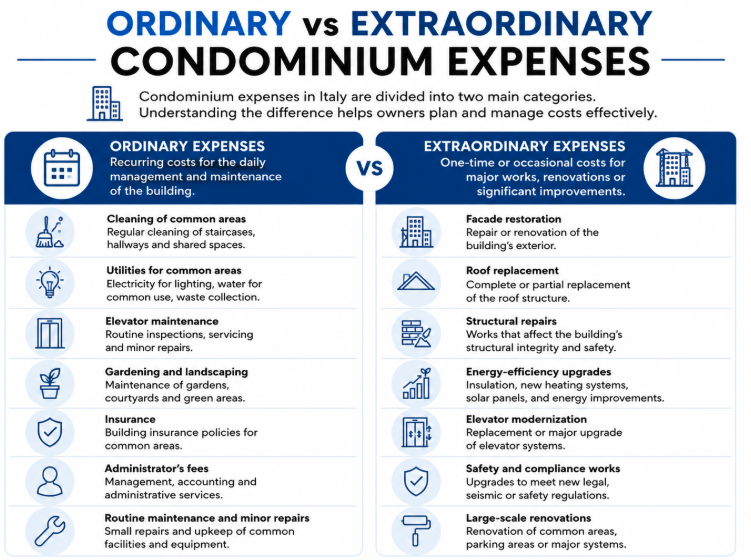
Condominium expenses in Italy are generally divided into two main categories: ordinary expenses and extraordinary expenses. Understanding the difference between these costs is essential for property owners, as they have different purposes, budgeting requirements, and approval procedures. While ordinary expenses cover the routine operation of the building, extraordinary expenses are associated with major repairs, renovations, or improvement projects that help preserve or increase the property’s value.
Ordinary Expenses: Recurring Costs Every Owner Pays
Ordinary condominium expenses are the regular costs required to keep the building functioning properly and maintain shared areas in good condition. These expenses are typically included in the annual condominium budget and are paid by owners through periodic installments, often on a monthly, quarterly, or semi-annual basis.
Common examples of ordinary expenses include cleaning services for common areas, electricity for hallways and staircases, elevator maintenance, gardening services, routine repairs, insurance premiums, waste management, and the administrator’s fees. In buildings with centralized heating or additional amenities, operating and maintenance costs for these services may also be included.
Because these expenses are recurring and relatively predictable, they represent the ongoing financial commitment associated with condominium ownership.
Extraordinary Expenses: Renovations and Major Repairs
Extraordinary condominium expenses refer to significant, non-routine costs that arise when major repairs, renovations, or improvements are required. These projects typically involve substantial investments and are not part of the building’s regular maintenance budget.
Examples of extraordinary expenses include facade restoration, roof replacement, structural repairs, elevator modernization, installation of new security systems, energy-efficiency upgrades, and improvements designed to comply with updated safety regulations. In recent years, many Italian condominiums have also undertaken energy renovation projects to improve building performance and reduce utility consumption.
Because these works often require considerable financial resources, owners may receive special assessments or payment schedules specifically designed to fund the project.
How Extraordinary Costs Are Approved and Shared
Unlike ordinary expenses, extraordinary works usually require formal approval from the condominium assembly before they can proceed. During a condominium meeting, owners review project proposals, evaluate costs, and vote on whether to authorize the work. The required majority depends on the nature of the project and the provisions of Italian condominium law.
Once approved, the cost of the project is allocated among owners according to the applicable expense-sharing criteria, which are often based on the building’s millesimi system. In some cases, however, expenses may be distributed differently if the work benefits only certain parts of the building or specific groups of owners.
Property owners are generally obligated to pay their share of approved extraordinary expenses, even if they disagreed with the decision during the vote. For this reason, prospective buyers should carefully review any planned or recently approved extraordinary works before purchasing a property, as these costs can significantly affect the overall investment.
Who Pays Condominium Fees in Italy?
One of the most important aspects of condominium ownership in Italy is understanding who is responsible for paying condominium fees. While property owners are generally liable for all condominium-related expenses, certain costs may be transferred to tenants through a rental agreement. Additionally, special rules apply when a property changes ownership, making it essential for both buyers and sellers to verify the condominium’s financial situation before completing a transaction.
Responsibilities of Property Owners
Under Italian law, the property owner is ultimately responsible for paying condominium fees. This obligation applies regardless of whether the property is occupied by the owner, rented to a tenant, or left vacant. Owners must contribute to the maintenance, management, and operation of the building’s common areas according to the allocation criteria established by the condominium regulations and the millesimi system.
Condominium fees are typically paid in installments according to a schedule approved during the annual condominium meeting. Payment deadlines vary from one condominium to another but are commonly monthly, quarterly, or semi-annual. Failure to pay on time can result in interest charges, collection procedures, and legal action initiated by the condominium administrator.
Because unpaid fees can create financial difficulties for the entire condominium community, Italian legislation provides administrators with legal tools to recover outstanding amounts from defaulting owners.
Condominium Fees for Tenants and Renters
Although the owner remains legally responsible toward the condominium, certain ordinary operating expenses can often be charged to tenants through the lease agreement. In practice, tenants usually contribute to costs directly related to the use and enjoyment of common services during their tenancy.
These expenses may include cleaning of common areas, elevator operation, lighting of shared spaces, gardening services, waste management, and routine maintenance of communal facilities. The specific costs that can be passed on to tenants depend on the terms of the lease and applicable regulations.
On the other hand, extraordinary expenses related to major repairs, renovations, structural works, or improvements generally remain the responsibility of the property owner. As a result, landlords must carefully distinguish between recoverable operating costs and expenses that cannot legally be transferred to the tenant.
What Happens When a Property Is Sold
When a condominium unit is sold, outstanding condominium fees become an important part of the transaction. Buyers should always review the condominium’s financial records and request information regarding any unpaid contributions or approved extraordinary works before completing the purchase.
As a general rule, sellers are responsible for condominium expenses that accrued during their period of ownership. However, Italian law provides certain protections for the condominium, and in some cases the buyer may become jointly liable for unpaid fees relating to the current year and the previous year. For this reason, notaries and real estate professionals often request documentation from the condominium administrator confirming the property’s financial status.
Special attention should also be given to extraordinary expenses. The allocation of these costs may depend on when the work was approved and when the payment obligation arose. To avoid disputes, buyers and sellers frequently negotiate and clearly specify in the sale agreement which party will be responsible for any pending or future condominium charges.
Conducting proper due diligence before a property transfer helps both parties avoid unexpected liabilities and ensures a smoother transaction.
How Condominium Fees Are Calculated
Condominium fees in Italy are not distributed equally among all property owners. Instead, they are calculated according to specific legal and administrative criteria designed to ensure a fair allocation of costs. The amount each owner pays depends on factors such as the size and value of their property, the nature of the expense, and the characteristics of the building itself. Understanding how these calculations work is essential for evaluating the true cost of owning an apartment in an Italian condominium.
The Italian “Millesimi” System Explained
The primary method used to calculate condominium fees in Italy is the millesimi system. Under this system, each unit within a building is assigned a value expressed in thousandths (millesimi) of the entire property. These values are determined based on factors such as the apartment’s size, location within the building, floor level, exposure, and overall value relative to the other units.
The total value of the building is conventionally divided into 1,000 shares. Each owner is responsible for paying a portion of condominium expenses corresponding to their allocated millesimi. For example, an owner holding 100 millesimi would generally be responsible for 10% of expenses distributed according to the standard ownership table.
While many costs are allocated using the general millesimi table, certain expenses may be divided according to specific criteria. For instance, elevator costs may be shared differently depending on the floor level of each apartment, while expenses related to particular facilities may only be charged to owners who benefit from them.
Ordinary vs Extraordinary Expenses
The calculation of condominium fees also depends on whether the expense is classified as ordinary or extraordinary.
Ordinary expenses include recurring costs necessary for the day-to-day operation of the building, such as cleaning services, lighting of common areas, gardening, routine maintenance, insurance premiums, and administrator fees. These expenses are typically forecast in the annual budget and divided among owners according to the applicable millesimi allocation rules.
Extraordinary expenses, on the other hand, arise from major repairs, renovations, or improvement projects. Examples include roof replacement, facade restoration, structural repairs, elevator modernization, and energy-efficiency upgrades. Because these projects often involve substantial costs, they are usually approved separately by the condominium assembly and may require additional contributions from owners beyond their regular condominium fees.
The allocation method for extraordinary works may vary depending on the nature of the project and the areas of the building affected.
Factors That Influence the Amount of Fees
Condominium fees can vary significantly from one building to another. Several factors influence the amount owners are required to pay each year.
One of the most important factors is the size and value of the individual property, as larger units generally hold more millesimi and therefore bear a larger share of common expenses. The characteristics of the building also play a major role. Condominiums with elevators, concierge services, gardens, swimming pools, gyms, private parking facilities, or centralized heating systems typically generate higher maintenance and operating costs.
The age and condition of the building can also affect fees. Older properties may require more frequent repairs and maintenance, while recently renovated buildings often benefit from lower short-term maintenance costs. In addition, location can influence expenses, as labor costs, utility rates, and service charges vary across different regions and cities in Italy.
For prospective buyers, reviewing past condominium budgets and financial statements is one of the best ways to estimate future costs and identify any upcoming extraordinary expenses that could impact the overall affordability of the property.
Buying property in Italy involves much more than finding the right home. Understanding condominium fees, ownership obligations, and potential future expenses is essential to making a well-informed investment. Whether you are relocating, purchasing a holiday home, or investing in Italian real estate, professional guidance can help you avoid unexpected costs and navigate the process with confidence.
If you are considering buying a property in Italy and would like personalized support, book a free consultation call with our team. We will answer your questions, explain the costs involved, and help you identify the best opportunities based on your goals and budget. A short conversation today can make your property purchase smoother, safer, and more successful.